
The method—going beyond
individual instruments.
The ten pillars TM & PARTNERS SCF uses to link wealth planning, investment decisions, and risk control.
A guide to understanding the rationale behind choices, asking more precise questions, and viewing the portfolio within the context of one’s overall wealth.
Download the position paper in Italian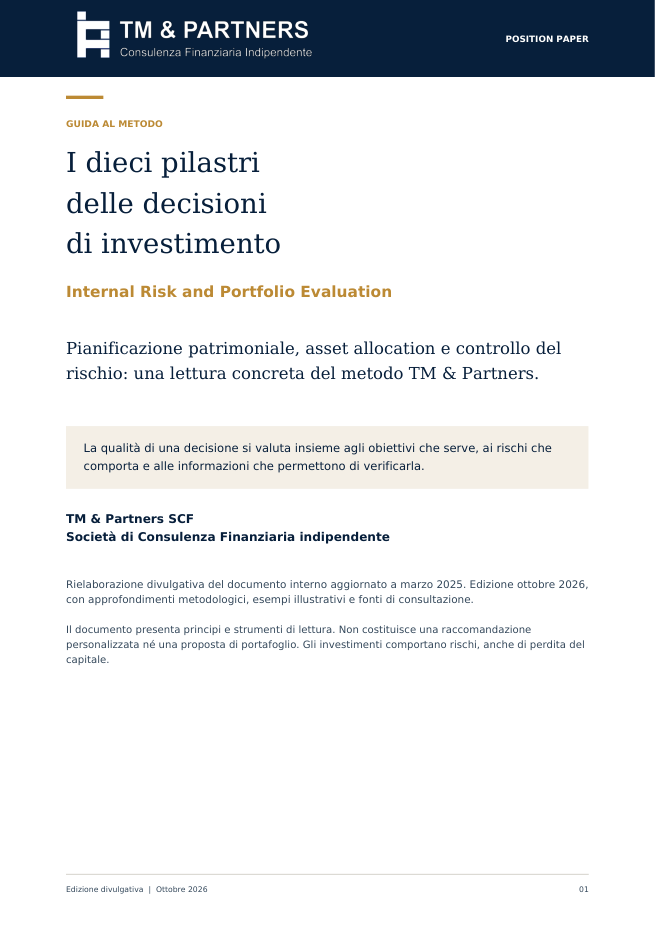
Goals first.
Then the portfolio.
The starting point is getting to know the client: time horizons, liquidity needs, constraints, and capacity to withstand losses. Asset allocation is built, instruments are evaluated, and the consistency of recommendations is verified based on this foundation.
This position paper outlines the firm’s investment philosophy. This new edition revises the internal document from March 2025, incorporating accessible explanations, illustrative examples, a glossary, and sources for further reading. The 2025 models are included for historical reference rather than as current investment proposals.
Our ten pillars.
Ten guiding principles that work in tandem: from portfolio architecture to the quality of client engagement.
IThe central role of asset allocation over the medium to long term
Portfolio architecture first, individual instruments second.
Asset allocation defines how investable capital is distributed across asset classes and risk sources. In the TM & PARTNERS SCF method, it serves as the backbone of our recommendations: it links client objectives to time horizons, liquidity needs, and the capacity to absorb losses. Instrument selection and tactical adjustments operate within this framework.
The question to ask: Which objectives and time horizons justify the current allocation of assets?
IIIntegrated and internalized quantitative and qualitative methodologies
Measurable data and professional judgment work together.
The original document outlines TM & PARTNERS SCF’s internal analysis process, which is also informed by external providers. Quantitative data facilitate the comparison of exposures, costs, volatility, and inter-investment relationships. Qualitative assessments allow for the interpretation of the economic context, instrument structure, and information quality.
The question to ask: What evidence supports the recommendation, and what assumptions could alter it?
IIIThe role of top-down macro quantitative models
Scenarios guide the analysis, with due regard for their limitations.
The top-down macro approach begins with the general economic framework to interpret potential implications for asset classes. Growth, inflation, interest rates, credit, and liquidity all contribute to constructing these scenarios. Models help organize these signals and compare alternative hypotheses.
The question to ask: How would the assessment change if the central scenario failed to materialize?
IVInvesting vs. trading: creating value over time
Objectives and discipline take precedence over trading frequency.
TM & PARTNERS SCF bases its recommendations on an investment-oriented approach. The starting point is the role of capital within the client’s plan: funding objectives, meeting upcoming obligations, and maintaining a manageable risk profile. Trading frequency must be driven by these needs and by justifiable reasons.
The question to ask: Does this transaction respond to a change in the plan, or is it a reaction to the moment?
VEfficiency and maximizing the return-to-risk ratio
Efficiency is assessed after accounting for costs, constraints, and risks.
The fifth pillar reflects the goal of achieving an efficient return-to-risk ratio. Evaluation focuses on the portfolio as a whole and the contribution of individual decisions. Expected returns, risks, and costs must be compared on a consistent basis; a superior estimated ratio does not guarantee a specific outcome.
The question to ask: Does the expected benefit of the change outweigh the costs and risks it introduces?
VIHybrid approach combining market risk and management risk
Market exposure and active choices must be evaluated separately.
In the TM & PARTNERS SCF model, portfolio construction combines diversified exposures with active choices, avoiding a strictly passive or strictly active approach. This is a methodological choice made by the firm, applied according to the individual client's objectives and constraints.
The question to ask: How much of the result depends on the markets, and how much on choices made relative to the benchmark?
VIIRisk profiling and wealth planning
The individual and their assets define the scope of available choices.
Portfolio construction begins with understanding the client: their objectives, financial situation, experience, constraints, and preferences. Emotional readiness to handle market fluctuations and the financial capacity to absorb losses are distinct dimensions. Even an investor accustomed to the markets may face time horizons that limit the level of risk they can sustain. [2]
The question to ask: What loss could I sustain without compromising essential expenses and priority goals?
VIIIMaximum diversification
Underlying exposures matter, not the number of products.
The method seeks broad diversification across and within asset classes, consistent with the client's profile. Countries, sectors, issuers, maturities, credit quality, and currencies help describe how risks are distributed. Diversification must be assessed based on the entire financial portfolio.
The question to ask: If a sector, currency, or issuer were to face difficulties, what impact would it have on the total?
IXChinese wall between asset allocation and risk management
Distinct roles make oversight more verifiable.
The original document assigns the structuring and review of models to the Investment Committee and risk monitoring to a specific internal department. This functional separation between those making proposals and those verifying them allows decisions to be checked against agreed-upon rules, limits, and policies.
The question to ask: Who verifies the risks of proposals, and how is the response to deviations documented?
XTransparency and client communication
Decisions become understandable and open to review.
TM & PARTNERS SCF considers communication an integral part of planning. The client must be able to understand the rationale behind recommendations, the risks assumed, the costs, and the observed results. Dialogue also enables the gathering of new information regarding goals, constraints, and risk sensitivity.
The question to ask: Can I explain why the portfolio is structured this way and when it will need to be reviewed?
From the principle to the practical question.
Each pillar is accompanied by an explanation, a practical application, an example, and a key point to consider. The goal is to make the reasoning transparent while clearly outlining the limitations of the estimates and models.
- VaR, volatility, drawdown, and stress tests: what they measure and what they overlook.
- Costs, liquidity, and concentration: viewing exposures as a whole.
- Nine models from the original document, with explicit dates and scope.
- Ten questions to prepare before meeting with your advisor.
Download the
position paper.
Enter your email address to access the complete PDF. The download becomes available immediately on this page. The PDF is currently available in Italian.
No automatic subscription to newsletters or marketing communications. Your address is recorded by TM & PARTNERS SCF to manage and document your request.
Download notice
The data controller is TM & PARTNERS SCF S.r.l., Via Carlo Gozzi 8, Fano (PU), info@tmandpartners.it. We collect the email address, the date of the request, and the version of the policy to facilitate the download and document the request, based on the measures requested by the data subject for the provision of the service (Art. 6, para. 1, letter b, GDPR). The email address is required to use this form; it is not added to marketing lists.
Requests are stored in the site’s log for 180 days following the last request; thereafter, they are removed from the active log and queued for deletion in accordance with the site’s technical processes. Authorized administrators and technical providers necessary for the site's operation may access this data, in accordance with their respective roles. No automated decision-making or profiling is performed for this service. Technical browsing logs remain governed by the Privacy Policy.
You may request access to, rectification of, erasure of, restriction of processing of, and portability of your data in the applicable cases by writing to the Data Controller; you may also lodge a complaint with the Italian Data Protection Authority (Garante per la protezione dei dati personali). For further information regarding data processing, please consult the Privacy Policy.
The position paper is for informational purposes only; it does not replace a personalized assessment. Investments entail risks, including the potential loss of capital; models and diversification do not guarantee future results.